Dublin Core
Title
A History of the Lovell Bus Line
Description
After the closure of the Concord, Maynard, and Hudson Street Railway a bus line was started by John Lovell in 1923 and it continued into the 1950s.
This monograph details the history of John Lovell and the Lovell Bus Lines in Maynard.
This monograph details the history of John Lovell and the Lovell Bus Lines in Maynard.
Creator
Terry Jones
Contributor
Terry Jones
Identifier
2026.61
Document Item Type Metadata
Text
LOVELL's BUS LINES - THIRTY YEARS IN MAYNARD
A Brief History
John F. Lovell is born in Plymouth, MA in 1858. He leaves school at age nine to work in a Plymouth nail factory. From eleven until twenty-one, he works on a relative’s farm in Carver, MA. At age 20, while living in Carver and listing his occupation as peddler, he marries Mary C. Burgess of Plymouth. She is eighteen. Soon after their marriage, the couple move to Plymouth and John works in a shoe factory. His career and life from that age to the post WW I years are recounted in materials contained in the Historical Society’s Collection.In 1918, Lovell (now age sixty and a life-long entrepreneur) is living in Woburn. He acquires a jitney bus, begins operations in Woburn and over the next several years develops his Woburn and Reading Bus Company into a small regional operation. He sells the company in 1922. In January of 1923, at age sixty-five, he forms Lovell’s Bus Company and purchases the former Concord, Maynard and Hudson Street Railway trolly barn in Maynard. From that site, he begins bus operations along some of the Concord, Maynard and Hudson Street Railway routes.
[The Concord, Maynard and Hudson Street Railway Company begins operations in August 1901 and ceases operations in January 1923. The history of that street railway company and its routes is told well in “Concord, Maynard and Hudson Street Railway”, by O. R. Cummings, published 1967.]
It appears that John Lovell moves to Maynard around 1923 when he begins his bus operation. He acquires one or more properties near the bus company’s car barn, and a loop road near the car barn is named Lovell’s Court. He and his wife Mary purchase and live in a house near Lovell’s Court at 69 Great Road.
Initially, John Lovell operates his bus company under the trade name of Concord, Maynard and Hudson Bus Line. However, he abandons that name at the end of 1924 as his bus routes now expand beyond those three towns. Already, Lovell’s Bus Company employs fourteen people and operates eleven buses and two taxis.
Over the next fifteen years or so John Lovell acquires numerous properties in Maynard, mostly multi-family homes. Records show that at least some of these are rented to his employees. At the same time, he expands his bus operations. In 1932, he acquires the White Bus Company routes. He operates that route structure as the Weymouth Division of Lovell’s Bus Company while operating the balance of his company’s routes as the Maynard Division.
Lovell buses run an extensive regional system, including: (a) east through Concord, Bedford and Lexington to Arlington, Cambridge and Watertown; (b) southeast to Sudbury, Wayland, Weston and Waltham; and (c) northwest to Acton, Stow, Hudson, Clinton, and Leominster.
As the Depression deepens during the 1930’s life gets harder, including for John Lovell and his employees. At some point, Lovell asks his employees to give back an earlier wage increase. It appears they do. But by 1934, employee-management relations at Lovell’s Bus Company are souring, and the Lovell’s employees vote to form a union. As reported in the Maynard News of September 14, 1934, John Lovell (represented by attorney Alfred McLeary) claims to have no knowledge of union organizing activity, insists he has been a generous employer, and he refuses to recognize the union. At the time, Lovell is paying his employees $4 a day, and the workday is apparently about nine to hours.
Employee and management relations remain unsettled during the next few years. And then in May of 1937 disagreements culminate in a four-day strike. The Maynard Enterprise for May 7, 1937 reports that while the employees wanted 70 cents an hour and an eight-hour day, the settlement is for 60 cents an hour (a 5 cent an hour increase) and a nine-hour day. In addition, John Lovell formally recognizes the Amalgamated Association of Railway and Streetcar Workers (an AFL affiliate) as representing his workers. As was the case during earlier employee-management disputes, John Lovell is represented by Alfred McLeary.
By 1939, Lovell’s Bus Company reports owning 63 buses, and it announces plans to purchase more. John Lovell is now in his early eighties, and he has acquired through the Lovell Bus Company a portfolio of properties in Maynard. Perhaps in order to finance the expansion of his operations, in 1939 he liquidates all or most of those investments. The MHS has in its collection a 1939 auction notice for the sale by Lovell’s Bus Company of twenty-four residential properties in Maynard, including the Lorenzo Maynard home on Dartmouth Street.
Throughout WW II, Lovell’s maintains operations, including through the difficulties of gasoline-rationing and younger employees being subject to the draft or electing to enlist. Then, with the war nearly won, In April 1945 John Lovell dies at age eighty-seven. The war in Europe ends a month later. It ends in the Pacific in August. Masses of young men and women begin to return to civilian life.
Following John Lovell’s death, operations at the bus company are taken over by one of John Lovell’s grandsons. However, like all for-profit, regional bus companies, Lovell’s struggles to compete with the post WW II explosive growth of private car ownership and the build out of highways.
In 1947, Lovell’s Bus Company sells its Weymouth Division, a set of routes and a collection of buses. The core of this sale appears to be the old White Bus Company purchased by Lovell’s in 1934. The purchaser is Hudson Bus Lines which was founded around 1932. Lovell’s Bus Company retains its Maynard Division.
The sale of the Weymouth Division is not enough to save Lovell’s Bus Company. After six more years of severe economic challenges, Lovell’s Bus Company ceases operations. Based on an August 27, 1953 article in the Maynard Enterprise, operations cease in the spring of that year. With the company’s demise it appears that all its routes are discontinued, with the following two exceptions.
A bus route between Maynard, Stow and Hudson operates for some years under the name Maynard Bus Service. The August 27, 1953 article noted above suggests the operation commences in the fall of 1953. The business is owned and operated by Maynard native Joe Mancini and his family. This new bus operation has evolved from a taxi service operated by Joe Mancini and named ‘G.I. Joe Taxi.’ It appears that Mancini’s bus service ceases operations in 1958.
The Lovell’s bus route from Maynard, through West Concord to Concord is taken over by The Middlesex and Boston Street Railway Company, which despite its name ran its last streetcars in 1930. From and after 1930, the Middlesex and Boston operates only buses. In 1972, the Middlesex and Boston bus operations are subsumed into the MBTA.
The MHS Lovell’s Collection as of Early 2026
The following summarizes as of early 2026 the Maynard Historical Society’s collection of material relating to Lovell’s Bus Company and its informal successor the Middlesex and Boston Street Railway Company. Note: You can access these items by clicking on the "Lovell Bus" tag in the sidebar.The collection includes:
- Numerous bus tickets and passes
- Full page and partial page newspaper ads from late 1941 for Lovell’s that give the following two timetables (i) Arlington to Leominster and to Maynard and on to South Acton and West Acton, and (ii) Lexington to Watertown through Arlington, Belmont and Waverly
- A Maynard to Waltham (through Sudbury, Wayland and Weston) timetable dated October 1942
- A Maynard to Harvard Square timetable dated April 1950
- An undated Maynard to Hudson Timetable with the phone number for chartering buses given as TWinoaks 7-2623 (the phone number dates this to circa mid-1950’s)
- A twenty page 1925 brochure offering a two night-three day bus tour of New Hampshire’s White Mountains; the cost being $27.50 per person which includes transportation, two nights’ accommodation, meals and guided tours (the brochure is described in detail at the end of this memo
- An operator’s daily report
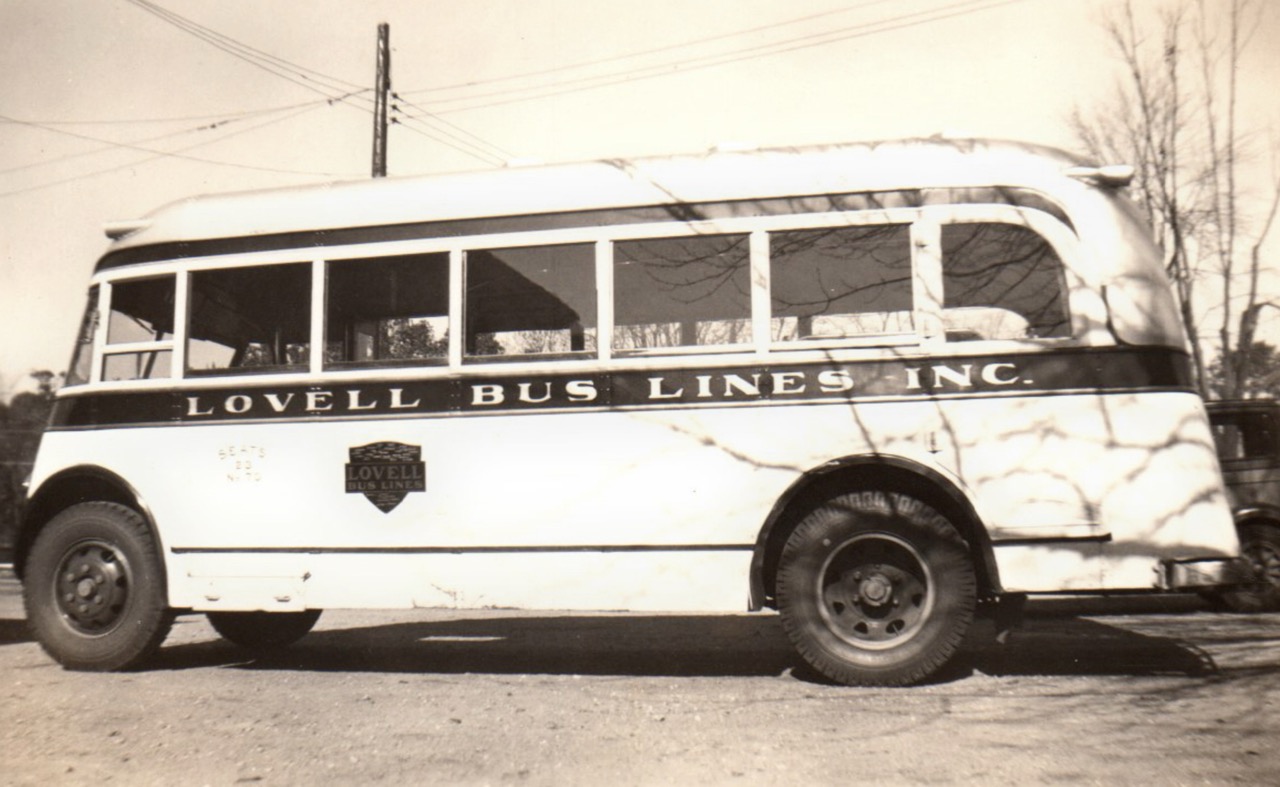
- Several pictures of Lovell buses
- A photocopy of a menu from Maynard’s Twin Trees Café on Maynard’s Powder Mill Road that reprints the bus schedule (the menu notes the café’s phone number as 191, and a three digit number dates the menu to pre-1955)
- Photocopies of several 1920’s-1930’s articles as to John Lovell and the Lovell Bus Company
- A copy of Maynard Memories, issue 20 from September – October of 2003, that reprints an article about John Lovell that first appeared in the Maynard High School paper The Screech Owl in 1939. That 1939 article is the source for some of the above.
- A ‘Report on the Concord, Maynard and Hudson Bus Line,’ prepared by Cyrus Hosmer, Jr. and Walter Henry Ridley of Concord MA., dated December 12, 1924. The Report was prepared for John Lovell at a time when the unofficial name for Lovell Bus Company was ‘The Concord, Maynard and Hudson Bus Line.’ The Report summarizes the first ten months of Lovell’s operations and offers a strategy for growing the company and improving its operations and financial performance. The Report itself is an interesting early example of the emerging practice of business consulting. The fact that John Lovell paid for such a report speaks to his entrepreneurship and willingness to experiment. For those interested in snapshot looks at life in 1924, the Report offers brief but intimate portraits of Concord Junction, Maynard, Stow, Gleasondale, Hudson, Berlin, South Action and West Acton as of that date.
The MHS collection also includes items not related to Lovell’s Bus Company but rather related to, or that appear to be related to, bus routes through Maynard after Lovell’s ceases operations early in 1953:
- There are two schedules for Middlesex and Boston buses that run a route from Maynard through Concord, Bedford Airport, Lexington and on to either Harvard Square or Arlington Heights. The schedules are dated September 1966 and May 1969.
- Several undated commutation tickets for the Middlesex & Boston Street Railway Company. It is unknown whether these tickets were for use on buses or were for use on the trollies run by the Middlesex and Boston up to about 1930. A 1912 map on Wikipedia Commons of the Middlesex and Boston trolly lines shows a line west from Bedford through Concord and then to Maynard and on to Berlin and Marlborough. Further research is necessary to properly identify these tickets.
The twenty-page brochure as to a White Mountains tour noted above is dated 1925 at page 5. It promotes and describes a Lovell’s Bus Company tour titled ‘Lovell’s White Mountain Tours,’ The brochure was mailed with a one and half cent President Warren G. Harding stamp (first issued in 1925) but with no addressee. The lack of an addressee indicates that the brochure was mailed as general advertising. The brochure contains numerous half-tone photos, including photos of several famous White Mountain hotels and of Lovell’s fleet headquarters in Maynard. The brochure was printed by Murphy &. Synder of Maynard.
As for that printing firm, Alpert Murphy and John Snyder start their business in 1917. In 1957, the business relocates to the corner of Waltham and Parker Streets in Maynard into a one-story building constructed in 1936 for the United Co-Operative Society. Murphy & Snyder cease operations in 2003. As of early 2026, the building at Waltham and Parker Streets retains the old Murphy & Snyder signage.
Original Format
Typed 8.5 x 11 in. paper
Six pages
Six pages